
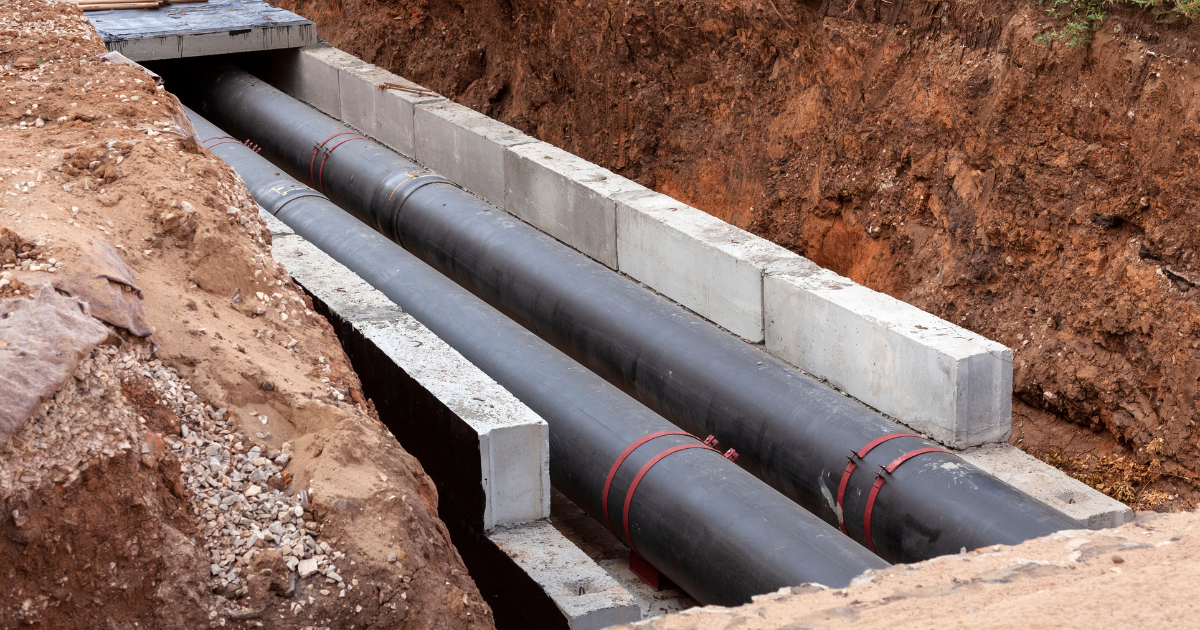
Since 2020, crises have piled up one after another. COVID-19, the wars in Ukraine and the Middle East, soaring energy prices, shrinking public budgets, labor shortages and the climate emergency have all forced the public works sector to adapt rapidly. In 2026, uncertainty continues to grow. Faced with external pressures that companies cannot control, how can they continue to improve their performance?
An industry under pressure for far too long
The current year presents a particularly challenging landscape for the public works sector. Over the past six years, successive crises have left lasting impacts on costs, supply chains, margins and long-term business visibility. Against this already difficult backdrop, four major pressures are now converging.
The lasting energy shock
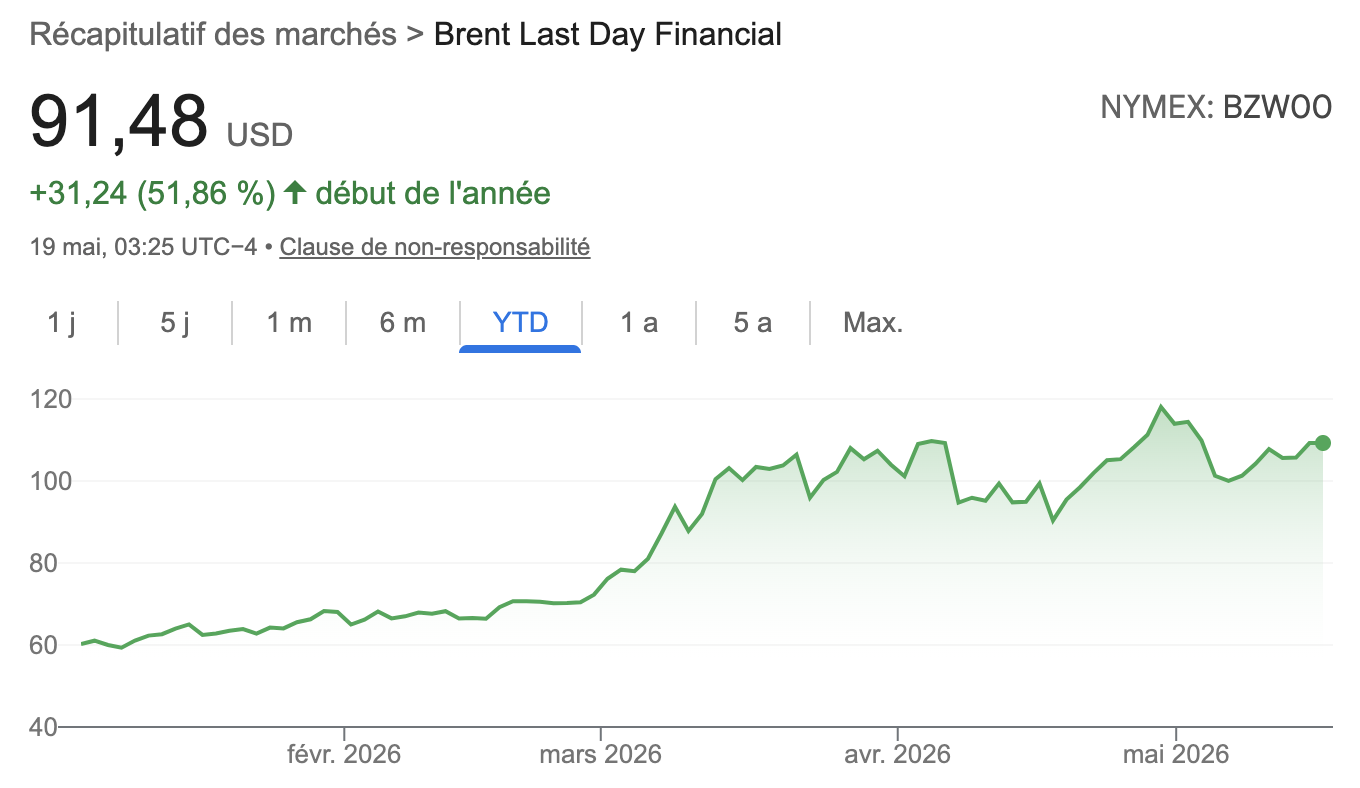
Brent crude oil, the global benchmark for oil prices, reached around $120 per barrel at the end of April 2026[1], its highest level since 2022 following disruptions in the Strait of Hormuz. For public works companies, which rely heavily on diesel fuel and petroleum-based materials, this volatility translates directly into higher operating costs. The situation is even more challenging as most government support measures introduced during previous crises—such as energy subsidies and price caps—have already been largely exhausted.
Fuel is only part of the problem. Bitumen prices have increased by 65% since the beginning of the conflict in the Middle East[2], resulting in a 10–12% increase in asphalt costs. At the same time, other bitumen-based materials have risen by between 5% and 35%, while PVC pipes have also been affected by higher raw material prices[3].
For contractors, the impact is immediate: higher energy prices place direct pressure on project profitability and cash flow.
Local government budget constraints
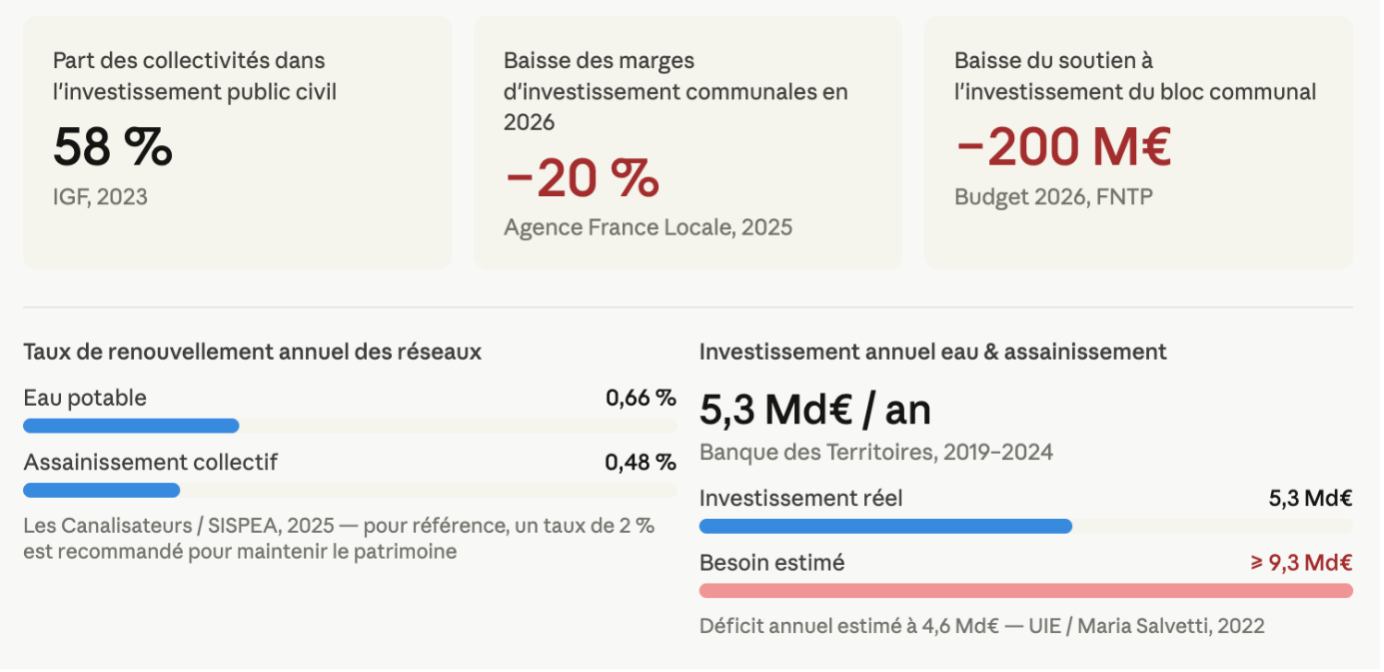
Local authorities account for 58% of France's public infrastructure investment[4], yet they are operating under increasingly constrained budgets. Associations representing local governments estimate that their investment capacity could decline by as much as 20% in 2026[5]. More specifically, financial support for municipal investment has been reduced by €200 million in the 2026 budget[6], representing a drop of nearly 11%.
Beyond the figures lies a broader governance issue. Many local authorities struggle to plan infrastructure projects beyond a single political term due to budget uncertainty. When priorities must be set, underground utility networks often compete with more visible public projects such as roads, public squares or urban redevelopment. As a result, the maintenance and renewal of underground infrastructure frequently take a back seat. Today, only 0.66% of drinking water networks and 0.48% of wastewater networks are renewed each year[7].
Climate pressure: an issue that can no longer wait
France has nearly one million kilometers of drinking water pipelines and approximately 400,000 kilometers of wastewater networks. The average leakage rate across drinking water distribution systems has reached 18.8%, meaning network efficiency stands at only 81.2%[8]. This represents more than one billion cubic meters of water lost every year—the equivalent of around 400,000 Olympic-sized swimming pools.
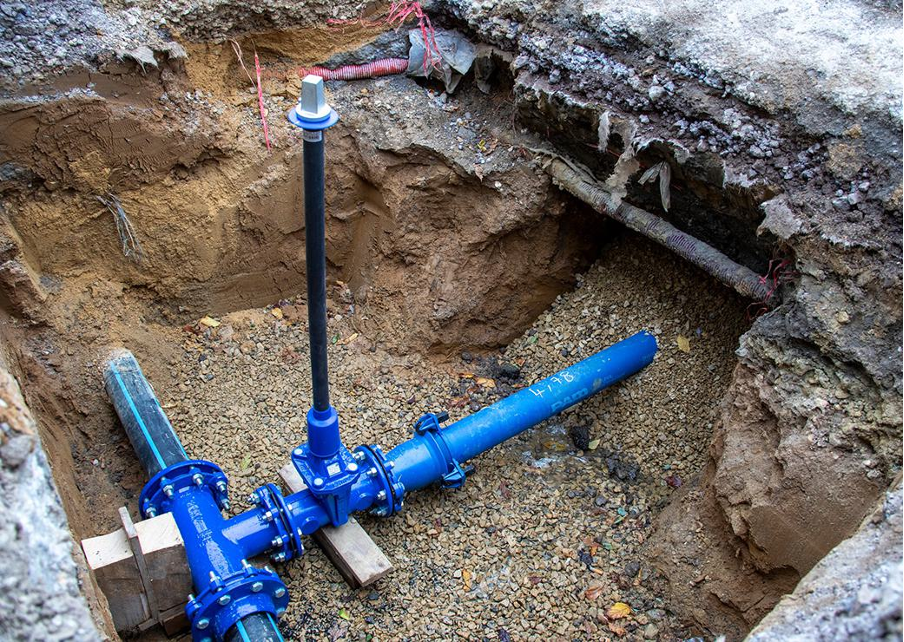
At a time of increasing water stress and recurring droughts, reducing these losses has become essential. The need to renovate, inspect and rehabilitate aging infrastructure is clear, yet these projects are constrained by the budgetary pressures described above. Between 2019 and 2024, annual public investment in water and wastewater infrastructure averaged €5.3 billion, but this remains well below estimated requirements[9].
The energy transition is further accelerating demand for new infrastructure projects.
The expansion of renewable energy—solar farms, wind farms and photovoltaic canopies—requires new electrical grid connections. The rapid adoption of electric vehicles is driving municipalities to install increasing numbers of charging stations. Meanwhile, district heating networks, which play a key role in decarbonizing urban heating, require major investments in pipelines and associated infrastructure.
Many of these projects, once financed primarily by local authorities, are now attracting private investment where economic returns are sufficient.
The energy transition is reshaping the entire utility infrastructure sector, creating demand both for the renewal of existing networks and the construction of new electricity, heating and pipeline infrastructure. For public works companies, this represents a genuine growth opportunity.
The recruitment crisis: the silent challenge
The public works sector is facing a structural challenge that continues to worsen: attracting, training and retaining skilled professionals. With nearly 256,000 employees across 7,562 companies in 2024[10], the industry depends on highly specialized expertise that takes years to develop and is difficult to replace. Yet careers in public works—diverse, highly technical and meaningful—continue to struggle with recruitment due to a lack of visibility and recognition.
This shortage affects every role, from field operations and engineering to office-based functions, forcing companies to rethink how they organize their work. When skilled staff become scarce, the challenge is no longer limited to recruitment and retention. It also becomes a question of working differently, training more effectively and extracting greater value from every working hour. Operational efficiency becomes not only a driver of performance but also a matter of long-term resilience.
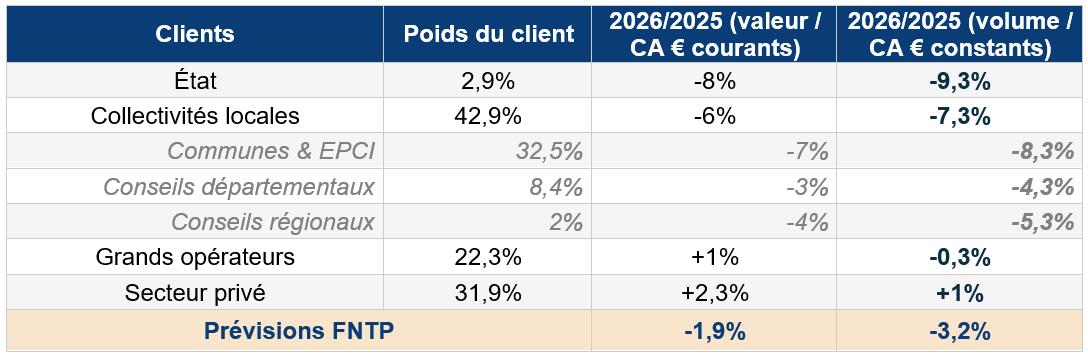
All indicators point in the same direction. Energy costs, public budgets, recruitment challenges and climate pressures continue to intensify with no sign of easing. Against this backdrop, the French National Federation of Public Works (FNTP) forecasts a 3.2% decline in production volume and a 1.9% decline in market value for 2026, while production costs are expected to rise by 1.3%[11]. Financial pressure across the entire industry is therefore expected to increase further.
The Hidden Costs
Faced with these pressures, one area remains firmly within a company's control: operational efficiency. And this is precisely where margins are won—or lost.
Public works companies negotiate purchasing contracts, optimize schedules and monitor margins down to the last euro. They know exactly what an hour of excavator time costs, what an idle truck represents and what delays from subcontractors mean financially. Yet there is another category of losses that often goes unnoticed: those created between the field and the office, within the flow of information itself. These hidden costs never appear in accounting systems, project reports or management dashboards. And yet they consume time, unnecessary travel and valuable human resources every day.
These losses cannot be negotiated away with suppliers, nor offset by winning additional contracts. They accumulate silently. At a time when every kilometer driven costs more, every unproductive hour has a greater financial impact and every skilled employee has become a scarce resource, these inefficiencies have become a strategic issue.
Taking Back Control of What You Can Control
Technology Doesn't Replace People. It Empowers Them.

The recruitment crisis facing the industry has no quick fix. Training a skilled surveyor or utility technician takes years. However, technology can fundamentally change the equation by enabling every employee to cover more projects without compromising quality or reliability.
Equipped with the right data capture and processing tools, a surveyor can now accomplish in a single day what previously required two or three. Fewer return visits, fewer manual corrections and data that is ready to use from the very first survey all contribute to restoring operational capacity—without increasing headcount. In an industry where skilled teams are under constant pressure, this represents an immediate and highly practical productivity gain.
What This Means in Practice
High energy prices, shrinking public budgets, ongoing recruitment challenges and growing pressure on natural resources—none of these issues can be solved overnight. They all share one common consequence, however: every operational inefficiency now costs significantly more than it did just a few years ago.
- An unnecessary site visit means fuel wasted at a time when oil prices remain above $100 per barrel.
- A data correction or return visit means another hour lost for a qualified technician in an industry already struggling to recruit.
- Poor estimates of material quantities—whether asphalt, backfill or aggregates—lead directly to higher costs for materials whose prices have risen sharply, while generating avoidable waste.
- Incomplete or inaccurate field data that delays as-built documentation means utility owners cannot properly maintain their assets, accelerating the deterioration of critical infrastructure.
Syslor's mission is to eliminate these hidden losses by designing solutions that streamline the entire geospatial data workflow—from field operations to office processing. In practical terms, this means:
- Ensuring that data captured or used in the field is immediately reliable, structured and ready to use, without unnecessary return visits or information loss.
- Enabling surveyors to manage more projects while maintaining the same level of quality and accuracy.
- Delivering data that provides long-term value for infrastructure owners and supports better operational decision-making.
At a time when every pressure is intensifying simultaneously, improving operational efficiency is one of the few levers companies can activate immediately—and one of the most profitable. The most successful projects are not always the ones people imagine. Sometimes, the greatest gains come simply from eliminating the work that never needed to be repeated.
Let's explore together where Syslor can create value for your operations: Request a demo.
Notes and References
- Brent Crude Oil Price , Boursorama, April 30, 2026. ↩
- Middle East Conflict: Bitumen, a Public Works Material Strongly Impacted , Batiweb, April 29, 2026. ↩
- Local Government Investment (October 2023) , Inspectorate General of Finance (IGF). ↩
- Rising Energy Prices Have an Immediate Impact on Construction Companies , Connaissance des Énergies, May 13, 2026. ↩
- 2026 Budget Bill: Local Authorities' Contribution to Restoring Public Finances , Agence France Locale, 2025. ↩
- 2026 Finance Act: What Changes for Public Works Companies , FNTP, 2026. ↩
- SISPEA Report 2025 (2023 data), Les Canalisateurs. Recommended renewal rate: 2% per year to maintain infrastructure assets. ↩
- SISPEA Report 2025 , 2023 data. ↩
- Banque des Territoires , 2024. Estimated annual investment requirement: €9.3 billion or more. Estimated annual funding gap: €4.6 billion (UIE / Maria Salvetti, 2022). ↩
- Public Works Market Study , Xerfi, 2026. ↩
- 2026 Public Works Industry Forecast , FNTP, November 2025. ↩
← Retour aux actualités